Choosing the Best Solar Generator for Your RV Needs: Your Guide to Off-Grid Freedom
Imagine waking up to the gentle hum of nature, miles from the nearest outlet, yet your coffee maker is brewing, your fridge is chilling, and your laptop is charged. This isn't a dream for RVers anymore; it's the reality made possible by choosing the best solar generator for your RV. These portable powerhouses are rapidly becoming the go-to solution for adventurers seeking true off-grid independence without the noise, fumes, or hassle of traditional fuel generators. But with so many options, how do you pick the right one for your rolling home?
This comprehensive guide cuts through the technical jargon, offering clear, actionable advice to help you find a solar generator that perfectly matches your RV lifestyle, whether you're a weekend warrior or a full-time boondocker.
At a Glance: Your Solar RV Power Playbook
- What it is: A portable power station combining a battery, inverter, and charge controller, often paired with separate solar panels.
- Why for RVs: Quiet, emission-free, fuel-independent, low maintenance, portable, and environmentally friendly.
- Key Considerations: Recharging time, initial battery cost, and the limits of running high-demand appliances like ACs.
- Core Components: Efficient monocrystalline solar panels, durable LiFePO4 batteries, a robust inverter for AC power, and a smart charge controller.
- How to Choose: Match capacity (Wh) to daily energy needs, output power (W) to appliance demands, and solar input to daily recharging requirements. Don't forget ports, portability, battery type, and your RV's existing electrical service (30A vs. 50A).
- Top Picks: Options range from compact units for small vans (e.g., EcoFlow River 2 Pro) to heavy-duty powerhouses for large rigs (e.g., EcoFlow Delta 2 Max, Bluetti AC200MAX, Jackery Explorer 2000 Plus).
Why a Solar Generator is Your RV's New Best Friend (or at least, its Most Useful Gadget)
For RVers, the allure of a solar generator is undeniable. It's more than just a power source; it's a gateway to quieter campsites and cleaner air. Unlike their noisy, fuel-guzzling cousins, solar generators offer a tranquil experience. You won't hear anything louder than a gentle cooling fan, and there are absolutely no harmful fumes or carbon monoxide emissions, making them safe for use inside your RV.
This fuel independence is a game-changer. No more hunting for gas stations in remote areas or hauling heavy fuel cans. The sun is your limitless fuel source, saving you money and expanding your itinerary options. Plus, solar generators are refreshingly low-maintenance – forget oil changes or air filter replacements. Their portability means you can move them between your RV, home, or even a backyard campout, adding incredible versatility to your power setup. It’s a truly clean energy solution, reducing your environmental footprint as you travel.
The Real-Talk Downsides
While the benefits are significant, it's essential to have a realistic understanding of a solar generator's limitations. Recharging to full capacity can take anywhere from a few hours to a full day or more, depending on sun conditions, panel size, and how much power you're drawing simultaneously. Patience, or ample solar input, is key here.
Another factor is cost. The battery alone often accounts for 90% or more of the generator's value. While durable, if a battery eventually needs replacing, it can be almost as expensive as buying a whole new unit. And while powerful, solar generators have their limits. They might struggle to run high-demand appliances like an RV air conditioner continuously for extended periods without a substantial battery capacity and a robust solar input. Short bursts, however, are often manageable with the right setup.
Solar Generators: How They Stack Up
Before diving into specific models, let's clarify where solar generators fit in the RV power landscape. They're a distinct solution compared to permanently installed solar or traditional fuel generators.
Against Rooftop Solar: Portability vs. Permanence
Rooftop solar systems are fantastic for continuous power generation, often providing more overall wattage for high-demand needs, especially with large arrays. They charge even when you're driving and are always exposed to the elements. However, they're permanent fixtures.
A solar generator, by contrast, is entirely portable. You can move it to optimal sun exposure, tuck it away in bad weather, or even take it into your tent. This portability is its superpower, making it ideal if you don't want to drill into your roof or need power in multiple locations.
Against Fuel Generators: Quiet, Clean, and Independent
Here's where solar generators truly shine. Fuel generators, while offering instant, high-wattage power, are notoriously loud (60-70 dB is common) and emit harmful fumes. They require constant fuel resupply and regular maintenance like oil changes.
Solar generators operate quietly and produce zero emissions. They run on the sun, eliminating fuel dependence and making them safe to run inside your RV (a big no-no for fuel generators). They also demand minimal maintenance, giving you more time for adventure and less time on upkeep. This independence from fossil fuels offers a kind of freedom that traditional generators simply can't match, enhancing your off-grid capabilities as outlined in Your guide to RV solar generators.
Inside Your Solar Powerhouse: Key Components Explained
Understanding what makes a solar generator tick helps you appreciate its capabilities and limitations.
- Solar Panels: These are the "eyes" that capture sunlight. Monocrystalline panels are generally preferred due to their higher efficiency (typically 15-22% cell efficiency) compared to polycrystalline panels, meaning they can generate more power from a smaller footprint – crucial for limited RV space.
- Solar Battery: The heart of the system, storing all that captured energy. For RV use, LiFePO4 (lithium iron phosphate) batteries are the gold standard. They offer superior power output, faster charging, reduced weight, a significantly longer lifespan (3,000+ charge cycles are typical), and a more stable chemistry, making them safer and more durable than older lead-acid options. Lithium-ion (NMC) is also a good choice, being lighter and more compact, but generally offers fewer cycles.
- Inverter: This essential component converts the direct current (DC) power from your solar panels and battery into alternating current (AC) power, which is what most of your RV appliances (microwaves, coffee makers, laptops) use. If you're running anything larger than a 5W panel and not exclusively DC devices, you need an inverter.
- Charge Controller: Think of this as the battery's bodyguard. It manages the flow of electricity, preventing overcharging or over-discharging the battery, which can significantly extend its lifespan. Look for MPPT (Maximum Power Point Tracking) controllers, as they are more efficient, ensuring optimal power extraction from your solar panels.
Choosing Your RV's Perfect Power Partner: The Core Criteria
Selecting the right solar generator requires a clear-eyed assessment of your needs. Here's a systematic approach to finding your match.
1. Capacity (Wh): How Much Juice Do You Really Need?
This is arguably the most critical factor. Capacity, measured in Watt-hours (Wh), tells you how much energy the battery can store. To figure out what you need, make a list of all the appliances you plan to run, their wattage, and how long you'll run them each day. Summing these up gives you your daily consumption. Remember to consider starting wattage for motor-driven devices like fridges or microwaves, as these can spike higher than continuous wattage.
- 700–1,000Wh: Ideal for small rigs, vans, or minimalist setups. Think 12V fridges, lights, fans, and charging electronics for weekend boondocking.
- 1,500–2,000Wh: Great for mid-size RVs, running full-size fridges, heavier device use, and supporting 2-3 days off-grid before needing a full recharge.
- 2,000Wh+: For larger rigs, extended boondocking, or those who crave high-comfort setups, including microwaves and induction cooktops.
A simple rule of thumb: Runtime (hours) ≈ battery capacity (Wh) ÷ average load (W).
2. Output Power (W): Running Your RV's Appliances
Output power, measured in Watts (W), refers to the continuous wattage the generator's inverter can supply. This determines what appliances you can run simultaneously and if you can handle high-draw items. Always check both the continuous and surge (peak) ratings, as many appliances (especially those with motors) have higher startup spikes.
- 800–1,000W inverter: Sufficient for small rigs and basic loads like lights, charging, and small electronics.
- 1,500–2,000W inverter: Standard for most setups, powering fridges, water pumps, and occasional kitchen appliances.
- 2,000–3,000W+ inverter: Necessary for larger rigs that want to run microwaves, induction cooktops, or even attempt short bursts of RV air conditioning.
3. Solar Input & Panel Sizing: Keeping Your Batteries Full
To truly achieve off-grid sustainability, you need enough solar input to match or exceed your daily energy consumption. The maximum solar input rating (e.g., 500W, 1000W) on your generator tells you how much solar power it can accept.
- 200–400W solar input: Good for smaller rigs and lighter loads, typically paired with 700–1,000Wh stations.
- 400–800W solar input: Ideal for mid-size RVs with 1,500–2,000Wh batteries, supporting moderate boondocking.
- 800–1,200W+ solar input: Essential for larger rigs, 2,000Wh+ batteries, and extended off-grid stays, especially if you plan to use power-hungry appliances.
Remember, the real-world output of solar panels is always less than their rated capacity. A 400W solar array might only average 200-300W of actual usable power daily due to angles, cloud cover, and temperature. More panels are always better if you have the space!
4. Ports, Wiring & RV Integration: Plugging In Safely
Look for a variety of output ports to accommodate all your devices:
- AC outlets: For your standard 120V household appliances.
- 12V car/Anderson outputs: Perfect for efficient 12V compressor fridges, fans, and some water pumps.
- USB-A and USB-C PD (Power Delivery 60–100W): Crucial for fast-charging laptops, smartphones, and other modern electronics.
For RV integration, you have a few options. The simplest and safest method is to plug your devices directly into the generator. For a more integrated experience, you can feed your entire RV's electrical system through its shore power inlet. This requires an adapter (e.g., a 30A to 15A adapter for a 30A RV) and careful management of your loads. Always turn off non-essential breakers in your RV when doing this, and never attempt to back-feed a campground pedestal or house circuit. If you're unsure, consult a qualified RV electrician.
5. Portability & Storage: On the Move
Solar generators come in various sizes and weights. Consider how often you'll move it and where you'll store it.
- Under 25 lb: Very easy to move around your RV or campsite.
- 25–50 lb: Manageable for occasional movement, but you might prefer to keep it in a primary spot.
- 50–70 lb+: These are more like semi-fixed appliances. Units with wheels and telescoping handles (like the Anker SOLIX F2000) are a huge plus for managing the weight.
Ensure you have enough space for the generator, allowing for adequate airflow for cooling, and easy access to all the plugs.
6. Battery Type, Safety & Lifespan: Longevity Matters
As mentioned, LiFePO4 (LFP) lithium batteries are the top choice for RV solar generators. They offer:
- Longer lifespan: 3,000+ charge cycles compared to a few hundred for lead-acid.
- Enhanced safety: More stable chemistry, reducing fire risk.
- Consistent power: Maintain voltage better throughout their discharge cycle.
- Reduced weight: Lighter than lead-acid for the same usable capacity.
Solar generators are inherently safe for indoor RV use because they produce no carbon monoxide or other harmful emissions.
7. 30 Amp vs. 50 Amp Service: Matching Your RV's Electrical System
Understanding your RV's electrical service is vital when considering how a solar generator integrates with your entire rig.
- 30-amp service RV: Your RV can draw a maximum of 3,600 watts (120V x 30A). You'd need a solar generator with at least a 3,000-3,600W inverter to fully utilize this.
- 50-amp service RV: This provides up to 12,000 watts (120V x 50A x 2 lines). A portable solar generator won't match this full capacity. When using an adapter (e.g., a 50A to 30A or 50A to 15A) to connect to a solar generator's output, your overall power will be limited to the lower rating of the generator or the adapter. Most portable solar generators are designed for 15A/20A outlets, meaning you'll effectively be limited to around 1,800-2,400W when plugged into an adapter.
8. Solar Cell Efficiency: More Power, Less Space
Efficiency, expressed as a percentage, indicates how much of the sun's energy a panel converts into electricity. Higher efficiency (e.g., 20% vs. 15%) means you can generate more power with fewer panels or from a smaller surface area – a significant advantage where space is at a premium, like an RV rooftop or a crowded campsite. Monocrystalline panels generally lead in this regard.
Top Solar Generators for RV Life: Our Picks & Why
Based on capacity, output, features, and user feedback, here are some of the best solar generators for RVs, catering to different needs and budgets.
For the All-Rounder RVer: Balanced Power & Versatility
These models strike a great balance between capacity, output, and features, suitable for most mid-to-large RVs.
- EcoFlow Delta 2 Max:
- Capacity: 2,048Wh (LiFePO4, ≈3,000+ cycles)
- AC Output: 2,400W (4,800W surge)
- Max Solar Input: ~1,000W
- Weight: 50 lb
- Best for: Most RVs. This is a superb all-rounder for RV and home backup. It can comfortably run compressor/residential fridges, lights, fans, water pump, electronics, and even handle a microwave, coffee maker, or induction cooktop (one or two at a time). Fast AC charging and excellent app control are major perks.
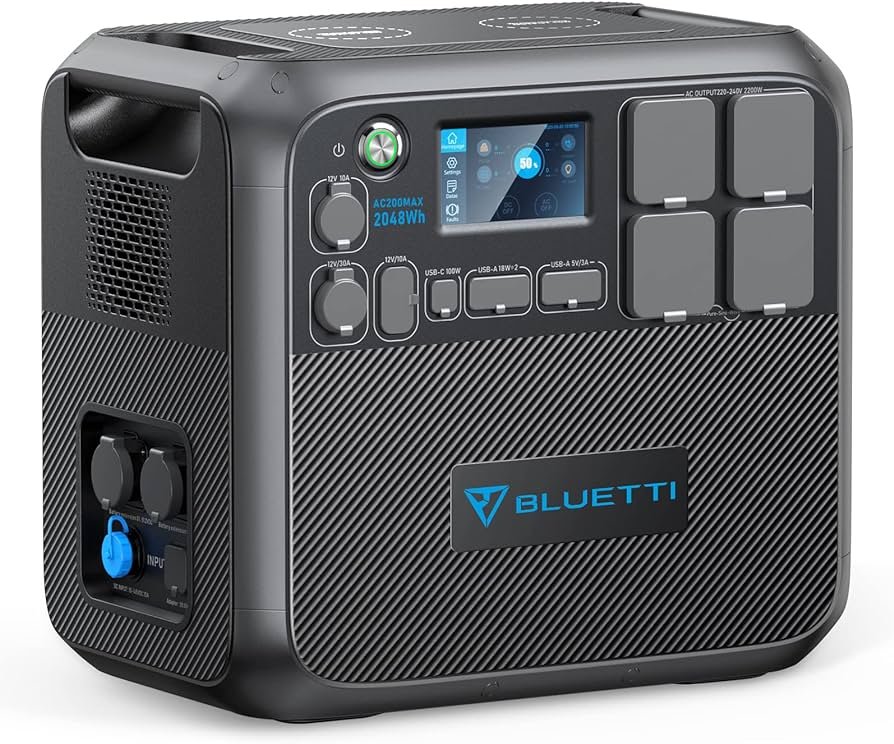
- Bluetti AC200MAX:
- Capacity: 2,048Wh (LiFePO4, very long cycle life)
- AC Output: 2,200W (4,800W surge)
- Max Solar Input: 900–1,400W
- Weight: ~62 lb
- Best for: Heavy-duty RVers and those seeking future expansion. Its robust solar input and ability to expand with external battery modules make it a long-term investment. It features a whopping 17 outlets and can run an RV AC in short bursts, especially with a soft-start kit.
- Jackery Explorer 2000 Plus:
- Capacity: 2,042Wh (LiFePO4)
- AC Output: 3,000W
- Max Solar Input: 1,200W
- Weight: 61.5 lb
- Best for: Modular, high-output RV systems. If you need to run multiple high-draw appliances or want more comfortable RV AC usage, the 3,000W output is a significant advantage. It integrates seamlessly with Jackery's own solar panels.
- Anker SOLIX F2000 (PowerHouse 767):
- Capacity: 2,048Wh (LiFePO4)
- AC Output: 2,400W
- Max Solar Input: 1,000W+
- Weight: ~67 lb
- Best for: Rugged boondocking adventures. This unit is built tough with a wheeled housing and telescoping handle, making its weight much more manageable. Anker's strong warranty provides extra peace of mind for long-term, off-grid use.
For Small Rigs & Minimalist Adventures: Lightweight & Efficient
If you're in a van, a pop-up, or just need power for essentials, these compact units offer excellent value and portability.
- EcoFlow River 2 Pro:
- Capacity: 768Wh (LiFePO4)
- AC Output: 800W (1,600W X-Boost for specific devices)
- Max Solar Input: 220–400W
- Weight: 17.2 lb
- Best for: Small rigs, vans, and light-duty boondocking. This lightweight generator can run a 12V compressor fridge for many hours, charge all your electronics, and power lights and fans. Its compact size and very fast AC charging (approx. 70 mins) are huge benefits for minimalist setups.
Mid-Range & Value Options (with strong features):
Several other models offer excellent performance within various price points, often with specific standout features.
- ALLPOWERS S2000 Pro (1,500Wh, 30-amp RV port): An affordable option that uniquely includes a dedicated 30-amp RV port, making integration easier for many. It often comes bundled with foldable, waterproof 22% efficient solar panels.
- Anker 757 Portable Power Station (1,229Wh, 5-year warranty): A smaller Anker option, known for its HyperFlash technology (80% charge in 1 hour with sufficient solar) and an impressive 5-year warranty.
- OUPES 2232Wh Portable Power Station (2,233Wh, EV charging station support): High capacity with incredibly fast charging options, including compatibility with EV charging stations for rapid top-ups.
- OUKITEL P2001 Solar Generator (2,000Wh, UPS function): Offers a great balance of capacity and features, including an Uninterruptible Power Supply (UPS) function, which can be handy for sensitive electronics.
- GRECELL 1997Wh Outdoor Solar Generator (1,997Wh, Dual 100W PD outlets): Another strong contender with UPS functionality and two high-power USB-C PD outlets for rapid device charging.
- EENOUR 2000Wh Portable Power Station (2,000Wh, Fast dual charging): Competitively priced with fast charging (AC + solar in 1.5 hours) and UPS functionality.
- Goal Zero Yeti 1000X (Under 1,000Wh, Heavy-duty construction): While on the lower end of capacity for full RV use, Goal Zero is renowned for its robust, anodized aluminum construction and reliability for demanding outdoor conditions.
When exploring these options, consider how well they meet the criteria we just discussed. A deeper dive into how these generators stack up against other power solutions can be found in Your guide to RV solar generators.
Your Burning Questions Answered: RV Solar Generator FAQ
How big should a solar generator for RV boondocking be?
For most mid-size RVs, aim for a 1,500–2,000Wh battery capacity with a 1,500–2,400W inverter, paired with 400–800W of solar panels. Smaller rigs (vans, pop-ups) can often get by with 700–1,000Wh. Larger rigs or those with high power needs should look at 2,000Wh+.
Can a solar generator run an RV air conditioner?
Sometimes, with significant caveats. Running an RV AC requires a generator with a strong inverter (2,000–3,000W), a very high surge capacity, and substantial battery capacity. Installing a soft-start kit on your AC unit is almost always recommended to reduce the startup surge. Most users find they can run AC in short bursts rather than continuously. For example:
- A 10,000 BTU AC needs a 2,500W+ generator (2,200W starting).
- A 13,500 BTU AC needs a 3,400W+ generator (2,900W starting).
- A 15,000 BTU AC needs a 3,800W+ generator (3,400W starting).
Is it safe to plug an RV shore power cord into a solar generator?
Yes, if done correctly and with caution. First, turn off non-essential breakers in your RV. Use an appropriate adapter (e.g., 30A to 15A) to plug your RV's shore power cord into one of the generator's AC outputs. Crucially, never back-feed a campground pedestal or house circuit as this can create a dangerous situation. Always monitor your load to ensure you don't overload the generator.
Do I really need solar panels?
For true off-grid boondocking beyond a day or two, yes, panels are essential. Without solar, your off-grid runtime is limited strictly to the battery's stored energy. Solar panels recharge the battery, extending your independence indefinitely (given enough sun).
Can I run an RV solar generator while driving?
Yes, absolutely. Solar generators are perfectly safe to run while driving because they don't produce harmful fumes, consume fossil fuels, or pose significant fire hazards. You can even charge them from your vehicle's 12V outlet while on the move, though this is typically a slow charging method.
Can I replace the batteries in my RV solar generator?
While technically possible for most units, replacing the internal battery is often approximately 90% of the generator's original cost. This makes buying a brand new unit a more economical and often simpler solution for most consumers.
How long does it take to charge a solar generator?
Charging time varies widely based on the battery capacity, the size/wattage of your solar panels, and the intensity of sunlight. For a full charge, it can range from under 5 hours (with high-wattage solar and ideal conditions) to over 20 hours (with smaller panels or less-than-ideal sun). Via AC wall outlet, many modern units can charge in 1-2 hours.
What will a 100W solar generator run?
A 100W (Watt-hour) solar generator is very small. It will primarily run small 12V devices and charge personal electronics: LED lights, phones, tablets, laptops, small table fans, and WiFi routers. It's suitable for very minimalist needs.
What size solar generator do I need to charge a 12V RV battery?
To calculate the required wattage:
- Determine your RV battery's amp-hour (AH) rating. For example, a 200AH battery discharged over 20 hours would draw 10 amps (200AH / 20 hours = 10 amps).
- Multiply amps by voltage to get watts: 10 amps x 12 volts = 120 watts.
To efficiently charge this, you'd want a solar generator that can output at least 150-200W of actual charging power. This typically means having at least 200W of solar panels (e.g., 1x200W or 2x100W panels) connected to a generator with sufficient solar input capacity.
For further exploration of how solar generators revolutionize off-grid living, make sure to consult Your guide to RV solar generators.
Your Next Steps: Powering Up Your RV Adventures
You now have the knowledge to confidently navigate the world of solar generators for your RV. The key is to match your power needs to the generator's capabilities, remembering that capacity, output, and solar input are your most crucial metrics.
Start by auditing your daily power consumption – list every appliance, its wattage, and how long you use it. This real-world data is your compass. Then, compare your needs against the recommended models and buying criteria. Don't be afraid to start with a slightly smaller unit if your budget is tight, and expand your solar panels later.
Embrace the quiet, clean power of the sun, and unlock a new level of freedom and enjoyment in your RV adventures. Happy boondocking!